

Jeanne Newby
Local streets are often named in honor of someone. Sometimes that name sticks, and sometimes it gets lost with time. Austin Street used to be named John Street in honor of John C. Webb, but that was changed by the City Council on Oct. 20, 1920. That’s when Joplin Street was renamed Broadway and Allen Street became Main Street. Until then, Main Street had gone east to the city limits. That was changed to Broadway.
The council minutes did not reflect why these changes were made. We have had streets named in honor of Grant Wistrom, Bob Baker and the Dawson family, just to name a few. Well, let’s talk about another local legend who had a street in Joplin named after him.
There is a section of West 26th Street heading into Maiden Lane that was known as Gabby Street. It was one of those cases where only the locals knew where Gabby Street was located. It was kind of like Stone’s Corner. There was no Stone’s Corner sign, but local people knew where Stone’s Corner was located and that it was named after Dr. Stone, who lived and had an animal clinic at that intersection.
Why would they name a street Gabby Street? Sounds like someone who talks too much. In reality, Gabby Street was a baseball legend, and since it’s baseball season, it would be a good time to recall this local hero. The name of the street was actually Gabby Street Boulevard.
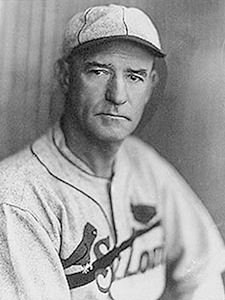
Charles E. “Gabby” Street was born in 1882 in Huntsville, Ala. He started his baseball career in 1904 with the Cincinnati Reds. He became a Boston Beaneater in 1906, joined the original Washington Nationals in 1908 and was traded to the New York Highlanders in 1912. That young man had a lot of changes in his baseball career. He also took time out from baseball to serve overseas in World War I, where he was wounded.
In 1920, Gabby decided to change from the playing side of baseball to the managing side. He started out with a ball club in Suffolk, Va. After two years he headed to Joplin to manage the Joplin Miners. After four years, he went on to the Muskogee team, then to the Augusta and Columbia clubs and then to Knoxville. He finally landed as the coach of the St. Louis Cardinals in 1929 and became manager in one season. That next year, 1930, the Cardinals won the National League Pennant. Joplin and the area baseball clubs were so proud of the former Joplin Miners team manager that they held a special banquet in his honor at the Roof Garden of the Conner Hotel. In 1931, the Cardinals won the National League again and went on to win the World Series against the Philadelphia Athletics.
Joplin was button-popping proud of its adopted Joplinite and once again gave a banquet in Gabby’s honor. Gabby Street stayed with the Cardinals until the end of the 1933 season. He purchased a home in Joplin in 1932 at 1529 Pennsylvania Avenue. He wintered in Joplin and followed his passion in the spring and summer.
In 1934, Gabby purchased the Barbee Estate, also known as the Levi Riseling property (northeast corner of 18th and Annie Baxter) in Joplin to settle down and raise his children, Sonny and Sally with him doing the restoration work. Street said of Joplin, “To me, this is the garden spot of the world and it will be my home from now on.” At this time he owned seven properties in Joplin.
Baseball was in Gabby’s blood, and it was hard to retire, so he went back to work being in charge of the St. Louis Browns then finally came home to Joplin.
Gabby Street’s other claim to fame occurred on Aug. 18, 1908, when he caught the first baseball from a 505-foot drop off the Washington Monument. Street was the first to say that there was another time a ball was dropped from the Washington Monument and it was August 29, 1894 (14 years prior to Gabby’s catch) when William (Pop) Schriver caught the ball but in actuality it hit Pop’s glove and he didn’t make the catch but was still noted in sports legend.
It took four tosses before Street was able to catch the ball. Street said, “Try catching a thing the size of a baseball flipped out of a window 505 feet above your head. You can’t even see it when it starts.” The question of how fast was the ball going when Gabby Street caught it became a challenge in schools and colleges all over the country and even to European institutions. It was finally determined by the government of the United States, when the Ordinance Department declared the ball was going 300 feet per second when caught by Gabby. And he said it gave his body quite a jar when he caught it. Billy Sullivan with the Chicago White Sox repeated the feat on Aug. 23, 1910. Gabby said he was offered $500 for the ball just after he caught it, but he kept his treasure.
In 1943, there was a war bond campaign and folks bid on some unusual items including Gabby Street’s 35-year-old relic – the baseball he caught at the Washington Monument. It brought in $12,500 with the final bid by George Newton, the Joplin jeweler. Newton returned the ball to Gabby. Once again at another war bond campaign, Gabby auctioned off his baseball relic and it brought in $14,500. And once again it was returned to Gabby as his treasure to keep.
In 1945, Gabby Street was honored to be the commentator and play-by-play announcer of all Cardinals and Browns games played at Sportsman’s Park.
Gabby Street passed away in February 1951 at the age of 69. Just a few years prior to his passing, Joplin dedicated and renamed West 26th Street as Gabby Street Boulevard in his honor.
Hail to baseball! Hail to a local hero! May the legend live on!

We use cookies to improve your experience on our site. By using our site, you consent to cookies.
Manage your cookie preferences below:
Essential cookies enable basic functions and are necessary for the proper function of the website.
Statistics cookies collect information anonymously. This information helps us understand how visitors use our website.
Google Analytics is a powerful tool that tracks and analyzes website traffic for informed marketing decisions.
Service URL: policies.google.com (opens in a new window)